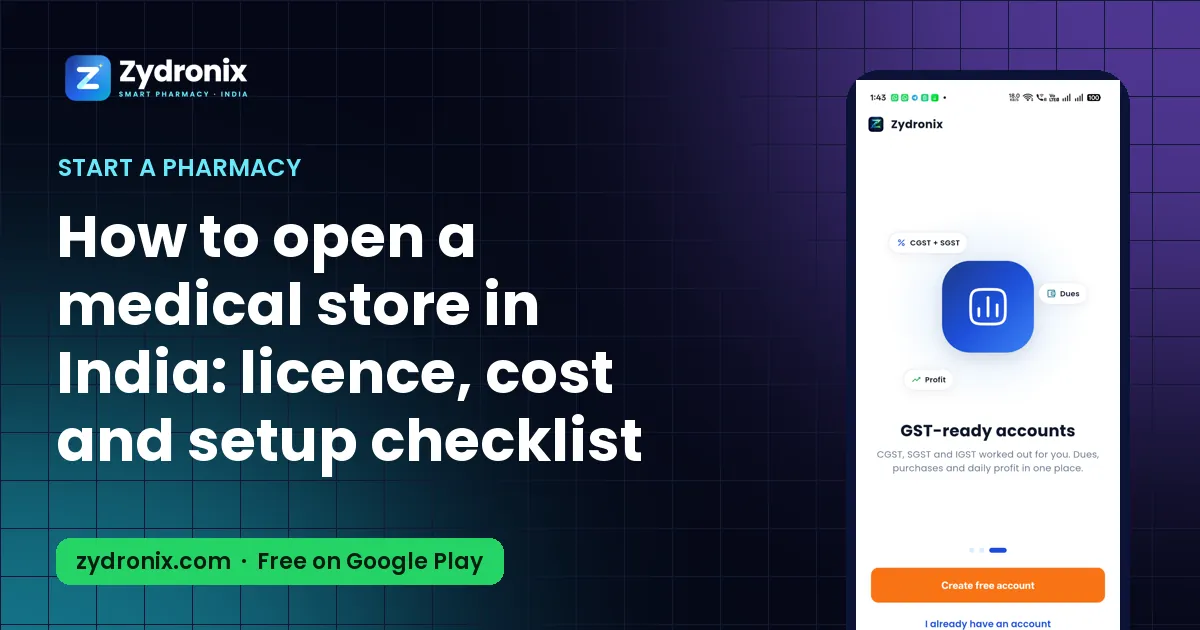
Opening a pharmacy is one of the steadier small businesses in India, but the licence process puts many people off. This guide lists the steps in order, the documents you will usually need, and the cost heads to plan for. Rules differ by state, so confirm details with your state drug control office.
Step 1: decide the type of store
| Type | Licence forms | Typical use |
|---|---|---|
| Retail chemist | Form 20 and Form 21 | Selling to patients at the counter |
| Wholesale distributor | Form 20B and Form 21B | Selling to chemists, hospitals, clinics |
| Retail plus wholesale | Both sets | One firm doing both |
Form 20 covers drugs other than those in Schedules C, C1 and X. Form 21 covers Schedule C and C1 drugs (biologicals such as vaccines and insulin). Most retail stores apply for both.
Step 2: the pharmacist
A retail drug licence needs a pharmacist registered with the State Pharmacy Council, present during business hours. If you are a pharmacist yourself (D.Pharm or B.Pharm with council registration), you can be the registered pharmacist. If not, you need to employ one, and their registration certificate goes with the application.
Wholesale licences usually need a "competent person" with a graduate degree and relevant experience, or a pharmacist, depending on the state.
Step 3: the premises
- Area: retail usually needs at least about 10 square metres, and retail plus wholesale about 15 square metres. Check your state's exact figure.
- A refrigerator for medicines that need cold storage.
- Clean, dry storage away from direct sunlight, with racks.
- A legal right to the premises: ownership papers or a rent agreement.
- A site plan or layout drawing, often required with the application.
Step 4: documents for the drug licence
States vary, but applications commonly ask for:
- Application in the prescribed form, with the fee for each form.
- Proof of the applicant's identity and address, and the firm's constitution (proprietorship, partnership deed, or company documents).
- Proof of premises: ownership or rent agreement, and a layout plan.
- Pharmacist's registration certificate, appointment letter and affidavit.
- Details of the refrigerator and storage.
- An affidavit that the applicant has not been convicted under the Drugs and Cosmetics Act.
Many states now take applications online, some through the Online National Drugs Licensing System (ONDLS). After the application, a drug inspector usually visits the premises before the licence is issued.
Try Zydronix free on your phone
GST billing, batch and expiry, udhaar and the H1 register. The free plan has no end date.
Step 5: GST and other registrations
- GST registration: compulsory once turnover crosses the threshold (₹40 lakh for goods in most states, lower in some special category states), and useful earlier because distributors and hospitals prefer registered buyers.
- Shop and establishment registration under your state's law, through the municipal body.
- A current bank account in the firm's name.
- Udyam (MSME) registration, optional but free and useful for loans and schemes.
Step 6: setup cost heads
Costs vary widely by city and size, so here are the heads to price locally rather than a single figure.
| Cost head | What to price |
|---|---|
| Rent and deposit | Usually the largest one-time cost in cities |
| Fit-out | Racks, counter, signage, lighting |
| Refrigerator | A pharmacy refrigerator with temperature display |
| First stock | The biggest working-capital need; many start with fast movers |
| Licences and registration | Government fees for each licence form, plus any consultant fee |
| Pharmacist salary | If you are not the pharmacist |
| Computer or phone, printer | A smartphone and a Bluetooth thermal printer can be enough at the start |
| Billing software | Free to start with Zydronix; paid plans as you grow |
Step 7: first stock
Start with what sells in your area: common antibiotics, pain relief, antacids, diabetes and blood pressure medicines, vitamins, OTC items, and baby care. Talk to two or three distributors, compare schemes and credit terms, and buy smaller quantities of slow movers.
Record every purchase with batch and expiry from day one. It is far easier than adding it later. Our guide to reducing medicine expiry loss explains the routine.
Step 8: billing from day one
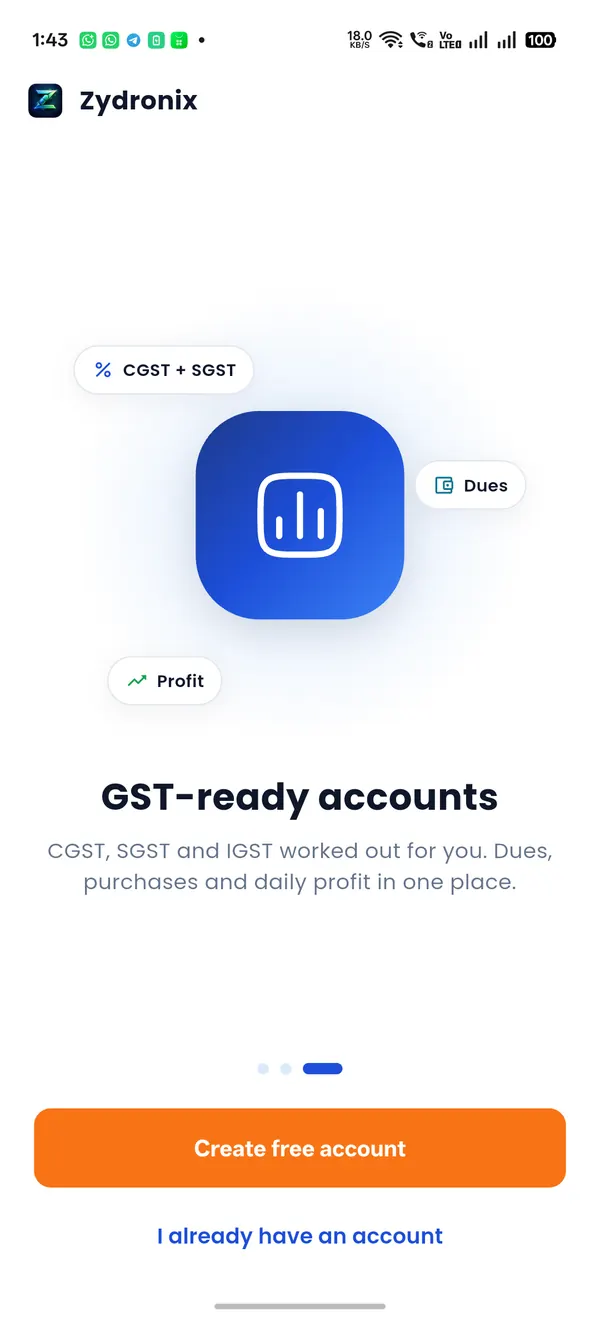
From the first sale you need GST bills with batch and expiry, the H1 register for H1 drugs, and a record of credit sales. Zydronix covers these on its free plan and comes with a catalogue of more than 2 lakh medicines, so you pick items instead of creating them one by one.
Choosing the location
A pharmacy's sales depend heavily on its spot. Places that work well:
- Near clinics, nursing homes, diagnostic labs and hospitals.
- On a main road in a residential area with no chemist within a short walk.
- Near a bus stand or market with steady footfall.
Count competing chemists within 500 metres, and talk to doctors nearby. A clinic that sends patients to your store can matter more than a busy road.
The first month: a simple routine
- Open with fast movers; add items as customers ask for them.
- Note every item a customer asked for that you did not have.
- Enter every purchase with batch and expiry from day one.
- Check the sales report weekly to see what is moving.
- Visit nearby doctors to introduce your store and timings.
Display and renewals
Display the drug licence and the pharmacist's registration where customers can see them. Licence validity and renewal rules differ by state, so note the dates and renew on time. Keep copies of all licences and registrations in one file, and a scanned copy on your phone.
हिंदी में सारांश
रिटेल मेडिकल स्टोर खोलने के लिए रजिस्टर्ड फार्मासिस्ट, लगभग 10 वर्ग मीटर की दुकान, राज्य ड्रग कंट्रोल विभाग से फॉर्म 20 और 21 पर रिटेल ड्रग लाइसेंस, ज़रूरत हो तो GST रजिस्ट्रेशन, शॉप एंड एस्टैब्लिशमेंट रजिस्ट्रेशन और दवाइयों के लिए फ्रिज चाहिए। पहले दिन से हर खरीद बैच और एक्सपायरी के साथ दर्ज करें। बिलिंग के लिए Zydronix का फ्री प्लान इस्तेमाल कर सकते हैं।
Frequently asked questions
What licence is needed to open a medical store in India?
A retail drug licence on Forms 20 and 21 from the state drug control department, plus GST registration where applicable and a shop and establishment registration.
Can I open a medical store without a pharmacy degree?
Yes, if you employ a registered pharmacist who is present during business hours. The pharmacist's registration certificate is part of the licence application.
How much space is needed for a medical store?
Usually at least about 10 square metres for retail and about 15 square metres for retail plus wholesale. Check your state's exact requirement.
How long does it take to get a drug licence?
It depends on the state and on how complete your application is. After you apply, a drug inspector usually inspects the premises before the licence is granted.
Which billing software is best for a new medical store?
A new store needs GST billing, batch and expiry tracking and the H1 register. Zydronix provides these on a free plan on Android, so you can start without a software cost.
Try Zydronix free on your phone
GST billing, batch and expiry, udhaar and the H1 register. The free plan has no end date.

Written by the team that builds Zydronix, the pharmacy billing app made by Tej Growth in Panipat. Facts on GST and drug rules change, so confirm details with your CA or state drug control office. Questions or corrections: legal@zydronix.com.