Ask any chemist what hurts margins most and expiry comes up quickly. A strip that expires on the shelf is a straight loss, and many distributors take returns only within a window before expiry. This guide is a routine you can start this week.
Why medicines expire on your shelf
Expiry loss rarely comes from one bad purchase. It builds up from small habits.
- Buying a full box to get a scheme, when the shop sells two strips a month.
- New stock placed in front of old stock, so the old batch never sells.
- Slow-moving items that nobody looks at until the date has passed.
- No record of which batch is where, so the shop cannot find what to return.
- Missing the distributor's return window, which is often a few months before expiry.
All of these have the same root: the shop does not know, item by item, what expires when.
Step 1: enter every purchase with batch and expiry
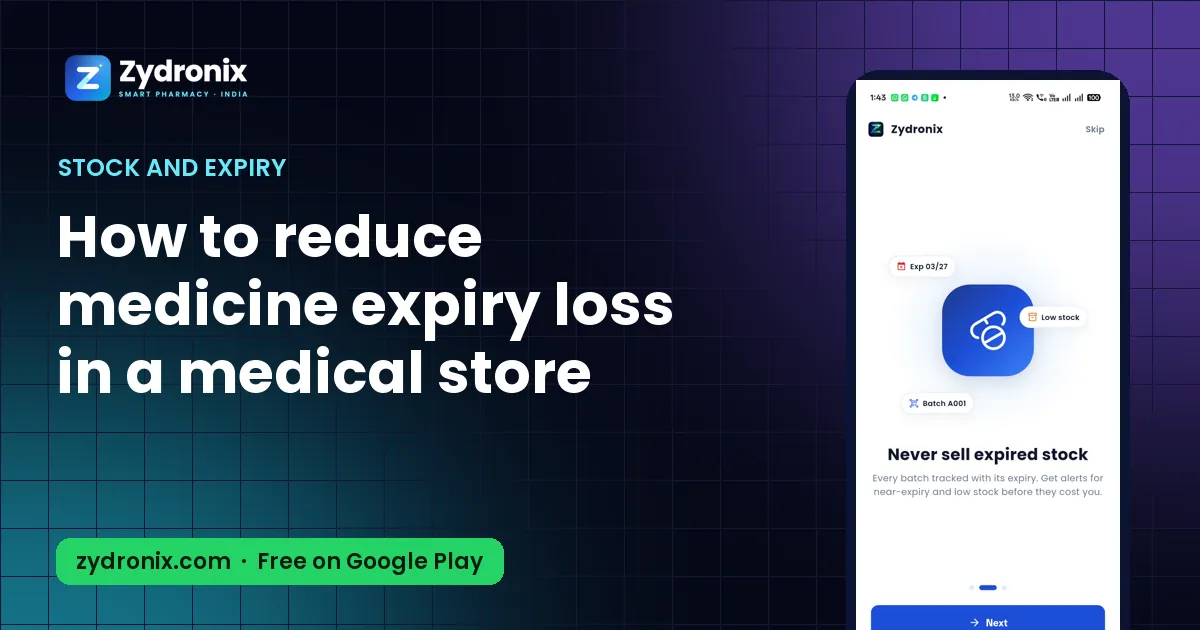
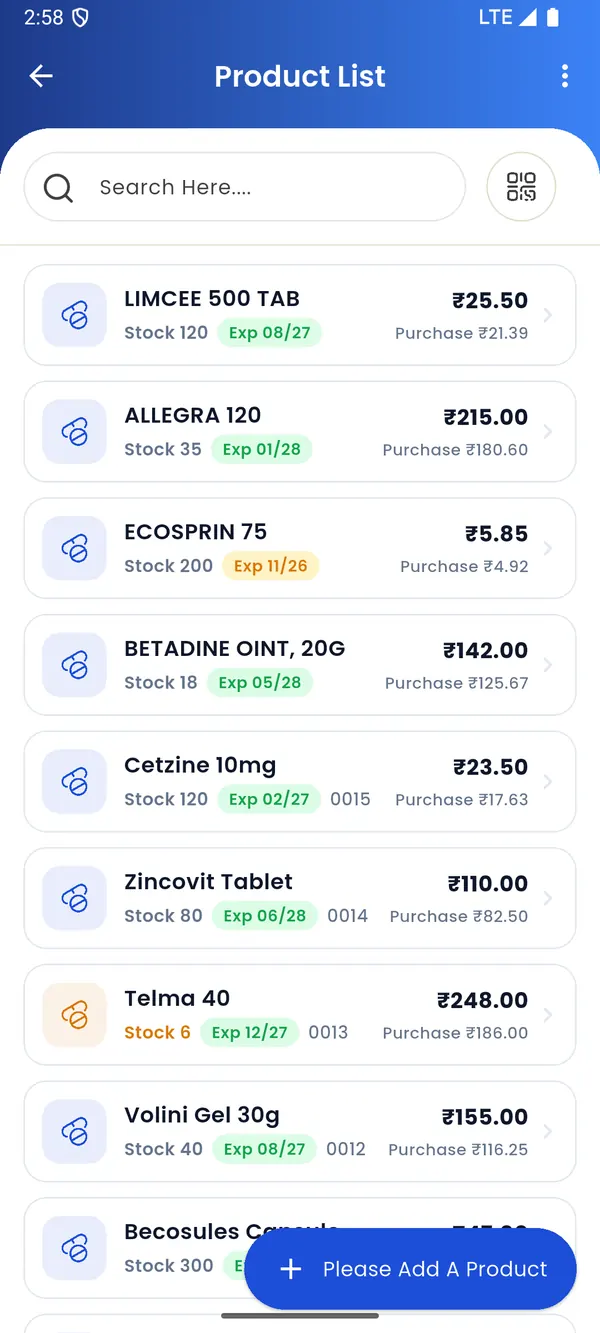
Expiry tracking starts at the purchase bill. Each line on the supplier's invoice has a batch number and an expiry date. If these go into your software, the rest is automatic. If they do not, no report can help you.
Typing a 40-line purchase bill takes time, which is why many shops skip it. Zydronix's AI bill scan reads a photo of the supplier invoice and fills the item, batch, expiry, quantity and rate. You check and save.
Step 2: the 90-60-30 day routine
Once expiry dates are in the system, run this routine every Monday. It takes about fifteen minutes.
| Days to expiry | What to do |
|---|---|
| 90 days | Move the batch to the front of the shelf. Offer it first at the counter. Stop reordering if you hold plenty. |
| 60 days | Check the distributor's return policy. Prepare a return list for items you will not sell in time. |
| 30 days | Return what you can. For the rest, consider a doctor-approved substitution or a small discount where allowed. |
| Expired | Move to a separate, labelled expired-stock area. Do not sell. Record and dispose as per rules. |
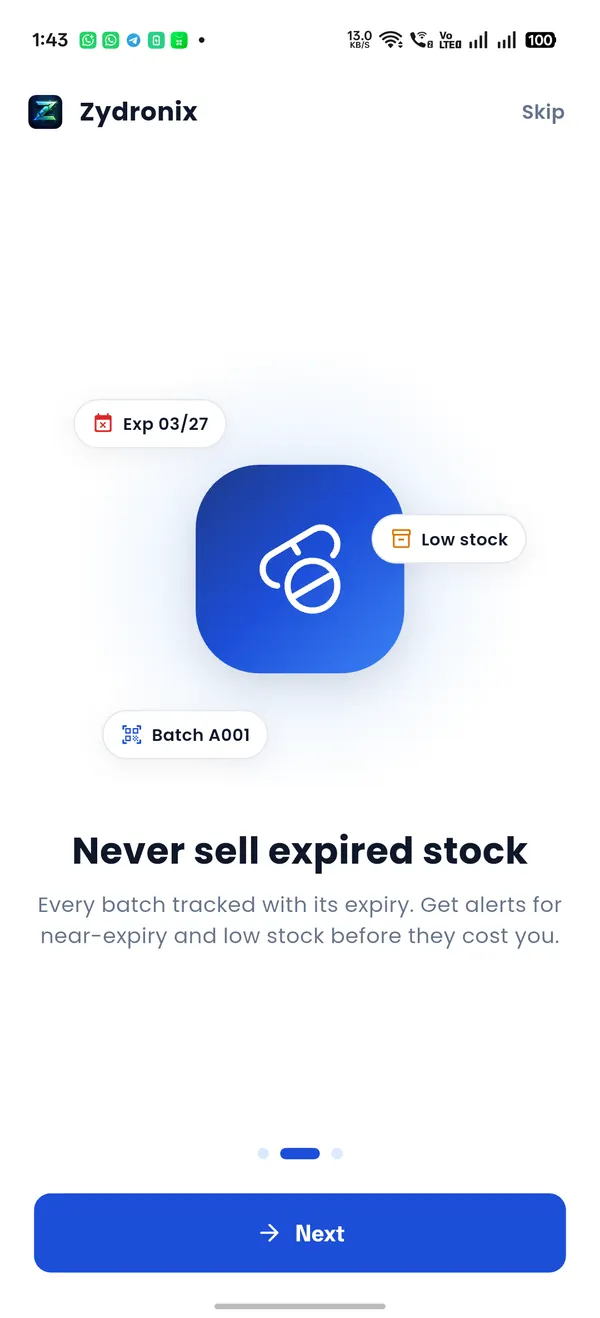
Zydronix shows a near-expiry list on the home screen, so you see it every time you open the app.
Try Zydronix free on your phone
GST billing, batch and expiry, udhaar and the H1 register. The free plan has no end date.
Step 3: first expiry, first out
FEFO (first expiry, first out) is the rule for medicines. When billing, the strip from the batch that expires first should go out first. On a busy counter, staff pick whatever is nearest.
Software helps here too. When you bill in Zydronix, each batch shows its expiry date on screen, so staff can pick the older batch before they hand over the strip.
Step 4: order smaller, order more often
Many expiry losses are really buying decisions. A scheme of "10 + 2 free" saves money only if you sell twelve strips before they expire.
- Use your sales report to see how many units of each item you sold in the last 90 days.
- For slow movers, buy the quantity you will sell in that period, even without a scheme.
- For fast movers, a scheme makes sense.
Zydronix's smart reorder list (on the Pro plan and above) suggests quantities from your recent sales, so you order what will move.
Step 5: returns to the distributor
Distributors accept returns under conditions that vary from firm to firm. Common ones: the strip must be sealed, the return must be made a certain number of days before expiry, and it must come with the original bill reference.
Because Zydronix stores the purchase bill for each batch, you can see which distributor supplied it and when. Build the return list from the 60-day list and send it with the bill numbers.
How much can you save?
The saving depends on your shop. A simple way to measure it: add up the MRP of everything you threw away or wrote off as expired in the last six months. That is your baseline. After three months of the routine, compare. Shops that start tracking expiry usually see the biggest drop in slow-moving and seasonal items.
Worked example: is the scheme worth it?
A distributor offers "10 + 2 free" on a syrup with a purchase rate of ₹60. Your shop sells about 4 bottles a month, and the batch expires in 4 months.
- Buying 12 bottles costs ₹600, so each bottle costs ₹50.
- In 4 months you expect to sell 16, so 12 bottles will sell in about 3 months. The scheme works.
- If the batch expired in 2 months, you would sell only about 8 bottles. The other 4 (₹200 at cost) would expire. Buying 6 bottles at ₹60 (₹360) would have been cheaper than losing ₹200 on the scheme.
The rule: a scheme saves money only if you sell the whole quantity well before expiry.
Seasonal medicines
Cough syrups, anti-allergy medicines, ORS and some antibiotics move with the seasons. Check last year's sales for the same months before you stock up, and reduce orders a few weeks before the season ends. Sales reports by month make this a two-minute job.
Storage that protects shelf life
Expiry dates assume correct storage. Keep medicines away from direct sun and damp walls, and store insulin, vaccines and some eye drops in the refrigerator at 2 to 8°C. A medicine kept badly can spoil before its printed date, and a customer complaint costs more than the strip.
हिंदी में सारांश
एक्सपायरी का नुकसान कम करने के लिए हर खरीद बैच नंबर और एक्सपायरी के साथ दर्ज करें, हर हफ़्ते नियर-एक्सपायरी लिस्ट देखें, 90 दिन पहले स्टॉक आगे रखें, 60 दिन पहले रिटर्न लिस्ट बनाएं और 30 दिन पहले डिस्ट्रीब्यूटर को लौटाएं। स्कीम तभी फ़ायदेमंद है जब पूरा माल एक्सपायरी से काफ़ी पहले बिक जाए। Zydronix होम स्क्रीन पर ही नियर-एक्सपायरी लिस्ट दिखाता है।
Frequently asked questions
How can I track medicine expiry in my medical store?
Enter every purchase with its batch number and expiry date in pharmacy software, then check a near-expiry list every week. Zydronix shows near-expiry stock on its home screen and can read batch and expiry from a photo of the purchase bill.
What is FEFO in a pharmacy?
FEFO means first expiry, first out. Sell the batch that expires first before newer batches, even if the newer batch arrived earlier.
How many days before expiry can I return medicines to a distributor?
It depends on the distributor's policy. Many ask for returns a few months before expiry with the original bill. Check with each supplier and plan returns from your 60-day list.
Is there a free app for medicine expiry alerts?
Yes. Zydronix's free plan includes batch and expiry tracking with near-expiry alerts on Android.
Can I sell expired medicine at a discount?
No. Selling expired medicine is not allowed. Keep expired stock apart, clearly labelled, and dispose of it as per the rules in your state.
Try Zydronix free on your phone
GST billing, batch and expiry, udhaar and the H1 register. The free plan has no end date.

Written by the team that builds Zydronix, the pharmacy billing app made by Tej Growth in Panipat. Facts on GST and drug rules change, so confirm details with your CA or state drug control office. Questions or corrections: legal@zydronix.com.