
Of all the paperwork in a medical store, the H1 register is the one most often skipped on a busy evening and then rushed before an inspection. This guide explains the rule, the format, and a way to have the register fill itself while you bill.
What Schedule H1 is and why it exists
The government added Schedule H1 to the Drugs and Cosmetics Rules in 2013, and it came into force in March 2014. The aim was to slow the misuse of antibiotics, which feeds antimicrobial resistance, and to control a few habit-forming drugs.
The schedule covers around 46 drugs. They include third- and fourth-generation antibiotics such as certain cephalosporins and carbapenems, anti-tuberculosis drugs, and some habit-forming medicines. The exact list is in the notification; your state drug control office can give you the current copy.
Packs of H1 drugs carry a boxed warning in red on the label, with the Rx symbol, stating that the drug is dangerous to take except under medical supervision and that it should not be sold without a prescription. If you see that box, the sale goes in the register.
What the H1 register must contain
For every sale of an H1 drug, record the following.
| Column | Example |
|---|---|
| Date of sale | 14-11-2026 |
| Patient name and address | Ramesh Kumar, Model Town, Panipat |
| Prescriber name and address | Dr S. Gupta, City Hospital, Panipat |
| Name of the drug | Example: an H1 antibiotic, 500 mg tablets |
| Quantity supplied | 10 tablets |
| Batch number (good practice) | AB1234 |
| Bill number (good practice) | S/26-27/00412 |
The rule itself names the first five items. Adding the batch and bill number makes it far easier to answer a query later, because you can trace the exact strip.
You must keep the register for three years from the date of the last entry. It can be a bound book, but the rules also accept records kept on a computer as long as they are complete and can be produced when asked.
How inspections usually go
A drug inspector visiting a retail chemist usually asks for the licence and the pharmacist's registration, checks storage (cold chain for vaccines and insulin, expired stock kept apart), and asks for purchase bills and the H1 register. Missing entries are among the most common findings.
The inspector may compare your H1 purchases with the register. If you bought 200 tablets of an H1 antibiotic last month and the register shows 40, you will be asked where the rest went. This is why the register should come from billing, not from memory at the end of the day.
Try Zydronix free on your phone
GST billing, batch and expiry, udhaar and the H1 register. The free plan has no end date.
Keeping the register on paper vs in software
A paper register is allowed and costs nothing, but it depends on someone writing an entry for every H1 sale while customers wait. In practice entries are skipped when the shop is busy.
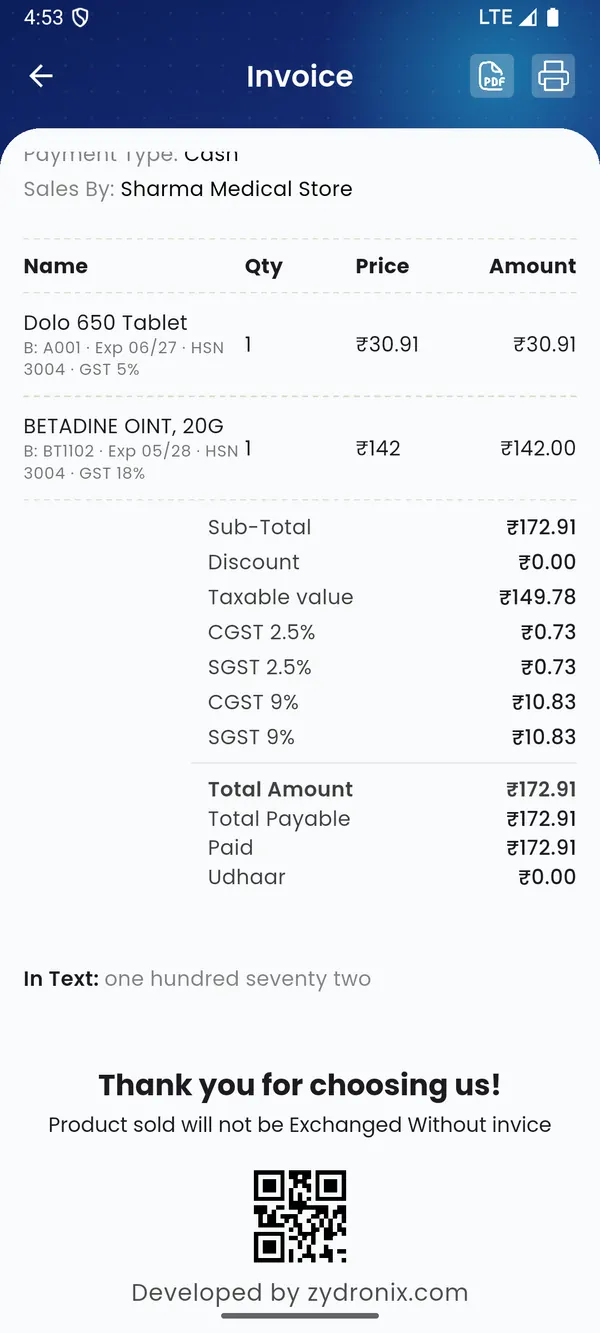
Software that marks H1 items in the medicine master can ask for the patient and doctor names at billing time and save the entry by itself. In Zydronix, once an item is tagged H1, the bill asks for these details and the register is updated as the bill is saved. You can export the register as a PDF for the inspector.
The benefits are plain:
- No separate writing step, so no missed entries.
- Batch and bill number are attached automatically.
- Search by patient, doctor, drug or date in seconds.
- The register cannot be lost, damaged by water, or misplaced.
Schedule H, H1 and X: what is different
Chemists often mix these up.
| Schedule | Prescription needed | Separate register | Notes |
|---|---|---|---|
| H | Yes | No separate register, but sale details go on the bill | Label says Rx and "Schedule H drug" warning |
| H1 | Yes | Yes, the H1 register, kept 3 years | Red boxed warning on label |
| X | Yes, with a copy kept by the chemist | Yes, and special storage and licence conditions | Narcotic and psychotropic substances |
For Schedule X drugs, the prescription must be retained, stock is kept under lock, and additional licence conditions apply. Most retail stores avoid stocking them unless they are attached to a hospital.
A short routine for H1 compliance
- Tag every H1 item in your medicine list once. Check new items as they arrive.
- Train staff to ask for the prescription for any item with the red box.
- Bill H1 items only through the software so the register entry is created.
- Once a month, compare H1 purchases with H1 sales in the register.
- Keep prescriptions or a photo of them for your own protection.
Handling prescriptions at the counter
For H1 drugs, the prescription is your protection. A simple counter routine:
- Look at the date. Old prescriptions for antibiotics need care; ask the patient.
- Check the doctor's name, registration number where shown, and the drug and strength.
- Supply only the quantity prescribed.
- Keep a photo of the prescription in your records, especially for antibiotics.
- If the prescription is unclear, call the doctor or ask the patient to get it clarified.
Common inspection findings, and how to avoid them
| Finding | Fix |
|---|---|
| H1 sales with no register entry | Bill H1 drugs only through software that creates the entry |
| Register missing patient address | Make address a required field for H1 items |
| Purchases of H1 drugs much higher than recorded sales | Monthly reconciliation of purchases vs register |
| Expired stock mixed with saleable stock | Separate, labelled area for expired goods |
| Pharmacist not present | Keep duty records; display registration |
Antibiotic misuse and why chemists matter
India is one of the largest consumers of antibiotics, and resistance is a serious public health problem. Schedule H1 puts the chemist in a position to slow misuse. Asking for a prescription can feel like losing a sale, but it is the law, and many customers respect a pharmacist who explains why.
हिंदी में सारांश
शेड्यूल H1 की दवाइयाँ सिर्फ़ डॉक्टर की पर्ची पर बेची जा सकती हैं और हर बिक्री H1 रजिस्टर में दर्ज करनी होती है: मरीज़ का नाम और पता, डॉक्टर का नाम और पता, दवाई का नाम और मात्रा। रजिस्टर तीन साल तक रखना होता है। H1 दवाई के पैक पर लाल बॉक्स में चेतावनी होती है। Zydronix में H1 दवाई का बिल बनते ही रजिस्टर में एंट्री अपने आप हो जाती है।
Frequently asked questions
What is the Schedule H1 register?
It is a record a chemist must keep of every sale of a Schedule H1 drug, with the patient's name and address, the prescriber's name and address, the drug name and the quantity. It is required under the Drugs and Cosmetics Rules, 1945.
How long do I keep the Schedule H1 register?
Keep it for three years. A drug inspector can ask to see it during that period.
Can I keep the H1 register in software instead of a book?
Yes, as long as every required detail is recorded and you can produce it when asked. Software such as Zydronix creates the entry from the bill and can export it as a PDF.
Which drugs are in Schedule H1?
About 46 drugs, mainly newer antibiotics, anti-tuberculosis drugs and some habit-forming medicines. Packs carry a red boxed warning with the Rx symbol. Get the current list from your state drug control office.
What happens if I do not keep the H1 register?
An inspector can record it as a violation. Depending on the state and the case, this can lead to a show-cause notice or suspension of the drug licence.
Try Zydronix free on your phone
GST billing, batch and expiry, udhaar and the H1 register. The free plan has no end date.

Written by the team that builds Zydronix, the pharmacy billing app made by Tej Growth in Panipat. Facts on GST and drug rules change, so confirm details with your CA or state drug control office. Questions or corrections: legal@zydronix.com.