GST is where most medical store owners lose time. The rates changed in 2025, suppliers updated their bills at different speeds, and old stock still had the earlier rate printed. This guide explains the current position in plain language and shows what your bill needs to contain.
The GST rate on medicines after the 2025 change
The GST Council's rate rationalisation took effect on 22 September 2025. For a chemist, the changes that matter are these.
- Most medicines and drugs moved from 12% to 5%.
- A set of life-saving drugs, including several used for cancer and rare diseases, moved to nil (exempt).
- Many medical devices and diagnostic items also moved to 5%, but not all. Check each one.
Your purchase bill is the best guide for a particular product. If your distributor charges 5% on a batch, sell it at 5% unless your CA tells you otherwise. If you still hold stock bought at the old rate, the selling rate is the rate in force on the date of sale.
HSN codes chemists use most
HSN (Harmonised System of Nomenclature) codes classify goods for GST. Medicines mostly sit in chapter 30.
| HSN | What it covers | Note |
|---|---|---|
| 3004 | Medicaments in measured doses or retail packs: tablets, capsules, syrups, injections | The code for most items on a chemist's shelf |
| 3003 | Medicaments not in measured doses or retail packs | Rare at retail |
| 3005 | Bandages, gauze, cotton, dressings | Check the rate on the purchase bill |
| 3006 | Some pharmaceutical goods such as sterile sutures, first-aid boxes | Mixed rates |
| 9018 | Medical instruments and devices | Rates vary by item |
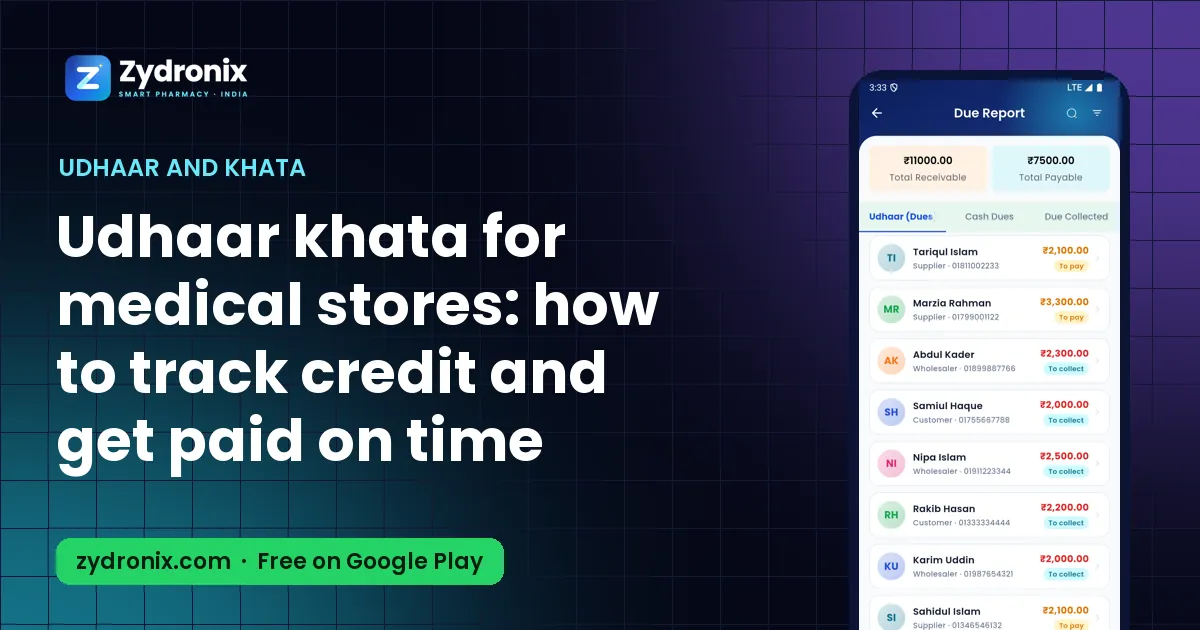
Under the GST rules, a business with turnover up to ₹5 crore must show at least a 4-digit HSN on B2B invoices. Many software products fill HSN 3004 by default for medicines. Zydronix's medicine catalogue does this, and you can change it for any item.
CGST and SGST, or IGST
The place of supply decides the tax type.
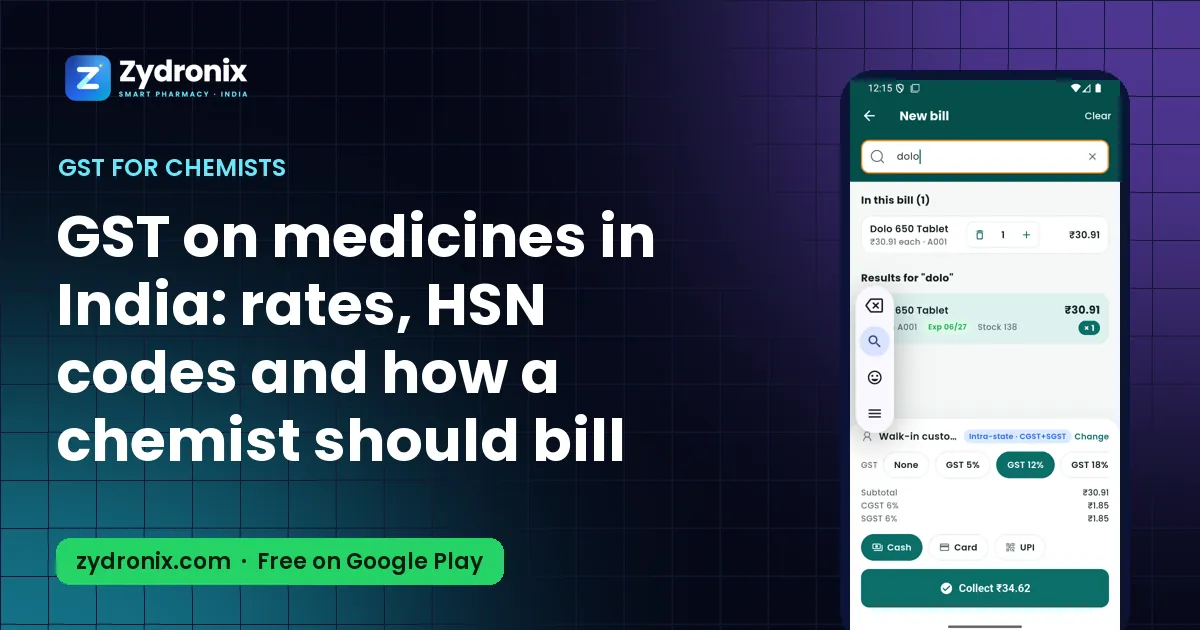
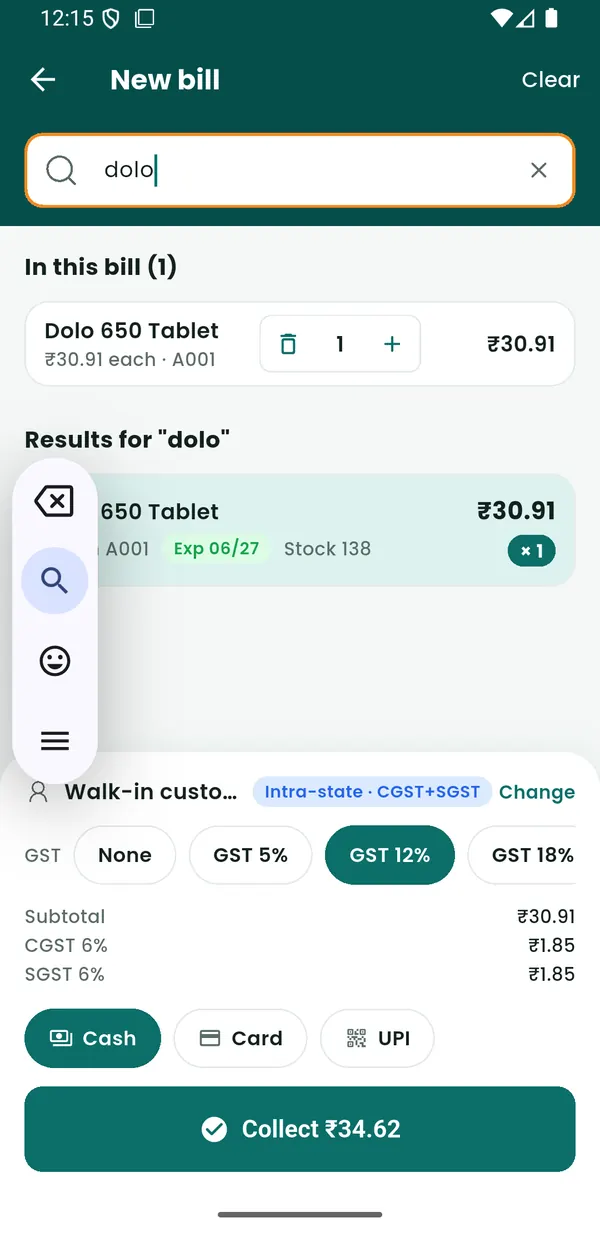
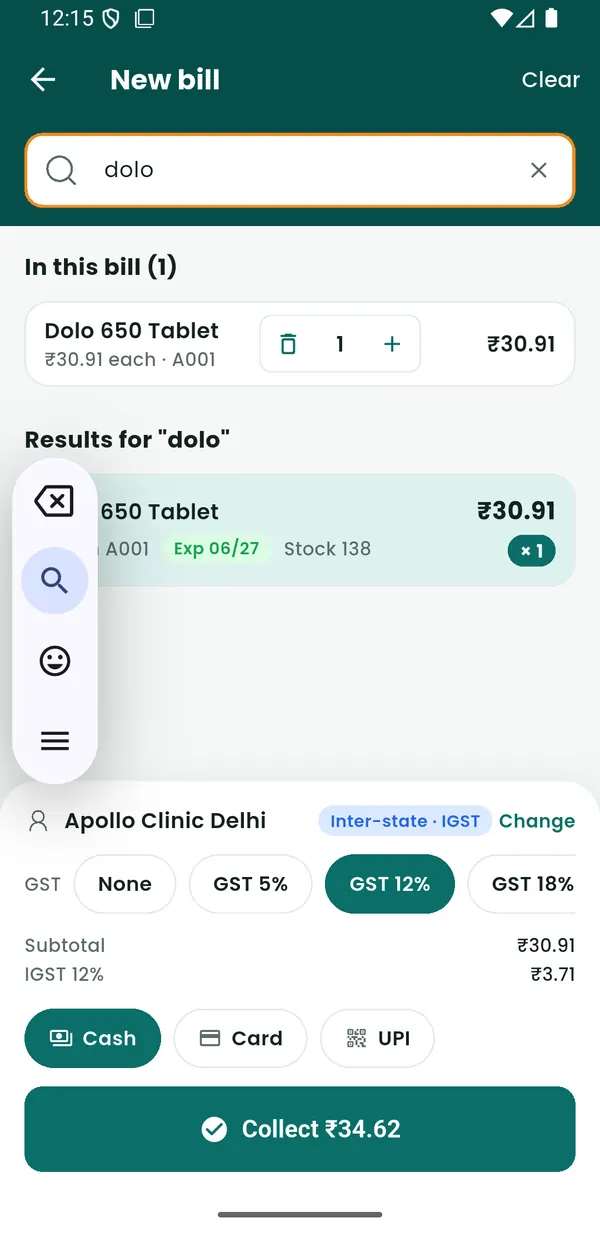
- If the buyer is in the same state as your shop, charge CGST and SGST, each at half the rate. On a 5% medicine that means 2.5% CGST and 2.5% SGST.
- If the buyer is a registered business in another state, charge IGST at the full rate.
- Walk-in retail customers buying at your counter are a local sale.
The mistake to avoid is charging IGST to a local buyer or the other way round. The tax is the same in total, but it goes to the wrong account and your CA will have to fix it in the return.
Try Zydronix free on your phone
GST billing, batch and expiry, udhaar and the H1 register. The free plan has no end date.
What a GST bill from a medical store must show
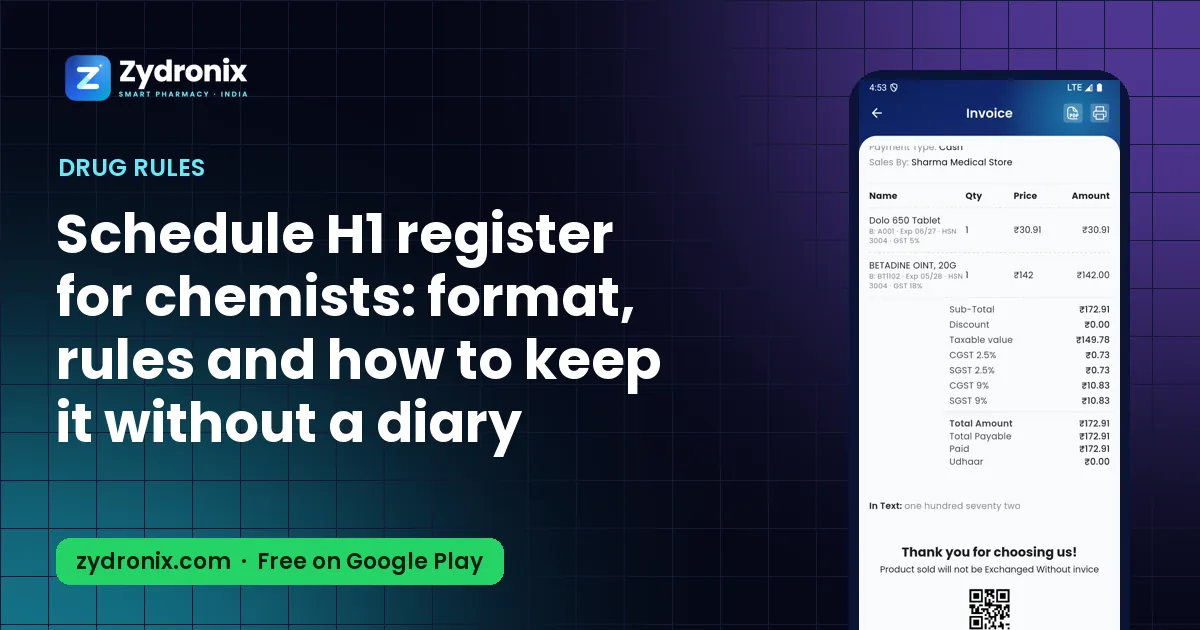
Rule 46 of the CGST Rules lists what a tax invoice contains. A pharmacy bill usually also carries details the drug rules ask for. Put together, a correct bill from a chemist has these parts.
- Your shop name, address and GSTIN.
- A serial number unique for the financial year, up to 16 characters, and the date.
- The buyer's name, address and GSTIN if the buyer is registered.
- For each item: description, HSN, batch number, expiry date, quantity, rate and taxable value.
- The GST rate and the CGST, SGST or IGST amount.
- The total, and the place of supply for an inter-state sale.
- Your drug licence number and, where your state requires it, the pharmacist's name.
- For Schedule H and H1 drugs, the patient's and prescriber's names.
- A signature or digital signature.
A bill made in Zydronix carries these fields once you fill your shop profile: GSTIN, drug licence number and address.
GST returns for a medical store
Most chemists file two returns.
- GSTR-1 lists your sales. Small taxpayers can file it quarterly under the QRMP scheme, or monthly.
- GSTR-3B is the summary return where you pay tax after taking input tax credit on purchases.
Input tax credit is the GST you paid your distributors. You can claim it only if the distributor has filed their own GSTR-1 so the purchase shows in your GSTR-2B. A good habit is to compare GSTR-2B with your purchase register every month before filing 3B.
Shops with turnover under the composition limit can choose the composition scheme and pay a flat rate, but they cannot collect GST on bills or claim input credit. Most chemists who buy from GST-registered distributors stay in the regular scheme. Ask your CA which suits you.
Common GST errors at the counter
- Selling at the old 12% rate after the change because the item master was never updated.
- Charging GST on the MRP instead of on the taxable value. MRP already includes GST; the taxable value is MRP minus the tax part.
- Giving a discount after tax instead of before tax, which changes the GST amount.
- Missing purchase bills, which means lost input credit.
Software helps with the first three because it calculates tax from the item master on every bill. The fourth needs a routine: enter every purchase bill the day it arrives. Zydronix's AI bill scan reads a photo of the supplier invoice so this takes a minute instead of half an hour.
Worked example: GST on a strip with MRP ₹105
Take a tablet strip with MRP ₹105 that carries 5% GST, sold to a walk-in customer in your own state.
| Step | Calculation | Amount |
|---|---|---|
| Taxable value | 105 ÷ 1.05 | ₹100.00 |
| GST at 5% | 100 × 5% | ₹5.00 |
| CGST (2.5%) | half of GST | ₹2.50 |
| SGST (2.5%) | half of GST | ₹2.50 |
| Bill total | 100 + 5 | ₹105.00 |
If you give a 10% discount on the bill, apply it to the taxable value first: ₹100 becomes ₹90, GST becomes ₹4.50, and the customer pays ₹94.50. Software does this on every line, which removes most rounding disputes at the counter.
Sales returns and credit notes
When a customer returns a sealed strip, issue a credit note that refers to the original bill. The credit note reduces your output GST for the month. For returns you make to the distributor, the distributor issues a credit note to you, and your input tax credit reduces by that amount. Keep both in your records; they appear in GSTR-1 and affect GSTR-3B.
A monthly GST routine for chemists
- Enter every purchase bill in the month it arrives.
- In the first week of the next month, download GSTR-2B and match it with your purchases.
- Chase distributors whose bills are missing from 2B.
- Share sales and purchase summaries with your CA.
- File GSTR-1 and GSTR-3B by the due dates.
हिंदी में सारांश
22 सितंबर 2025 से ज़्यादातर दवाइयों पर GST 5% है और कुछ जीवन रक्षक दवाइयाँ टैक्स-फ्री हैं। ज़्यादातर दवाइयों का HSN कोड 3004 है। अपने राज्य में बिक्री पर CGST और SGST लगेगा, दूसरे राज्य के रजिस्टर्ड खरीदार को IGST। MRP में GST पहले से शामिल होता है, इसलिए टैक्स MRP पर नहीं बल्कि टैक्सेबल वैल्यू पर बनता है। हर दवाई का रेट अपने डिस्ट्रीब्यूटर के बिल और CA से पक्का करें।
Frequently asked questions
What is the GST rate on medicines in India now?
Since 22 September 2025, most medicines are taxed at 5% GST. Some life-saving drugs are exempt, and certain medical devices have other rates. Check the rate on your distributor's invoice for each product.
What is the HSN code for medicines?
Most packed medicines such as tablets, capsules, syrups and injections use HSN 3004. Bandages and dressings use 3005, and medical devices often fall under 9018.
Do I charge CGST and SGST or IGST at a medical store?
For counter sales and buyers in your own state, charge CGST and SGST, each at half the GST rate. For a registered buyer in another state, charge IGST at the full rate.
Is GST calculated on the MRP of a medicine?
No. MRP includes GST. The taxable value is the price before tax, so for a 5% item the taxable value is MRP divided by 1.05, and GST is the difference.
Can pharmacy software prepare my GST returns?
Software such as Zydronix keeps sales and purchase data in the format your CA needs and gives GSTR-1 and 3B summaries. On the Gold plan Zydronix prepares the return data each month. Filing is still done on the GST portal by you or your CA.
Try Zydronix free on your phone
GST billing, batch and expiry, udhaar and the H1 register. The free plan has no end date.

Written by the team that builds Zydronix, the pharmacy billing app made by Tej Growth in Panipat. Facts on GST and drug rules change, so confirm details with your CA or state drug control office. Questions or corrections: legal@zydronix.com.